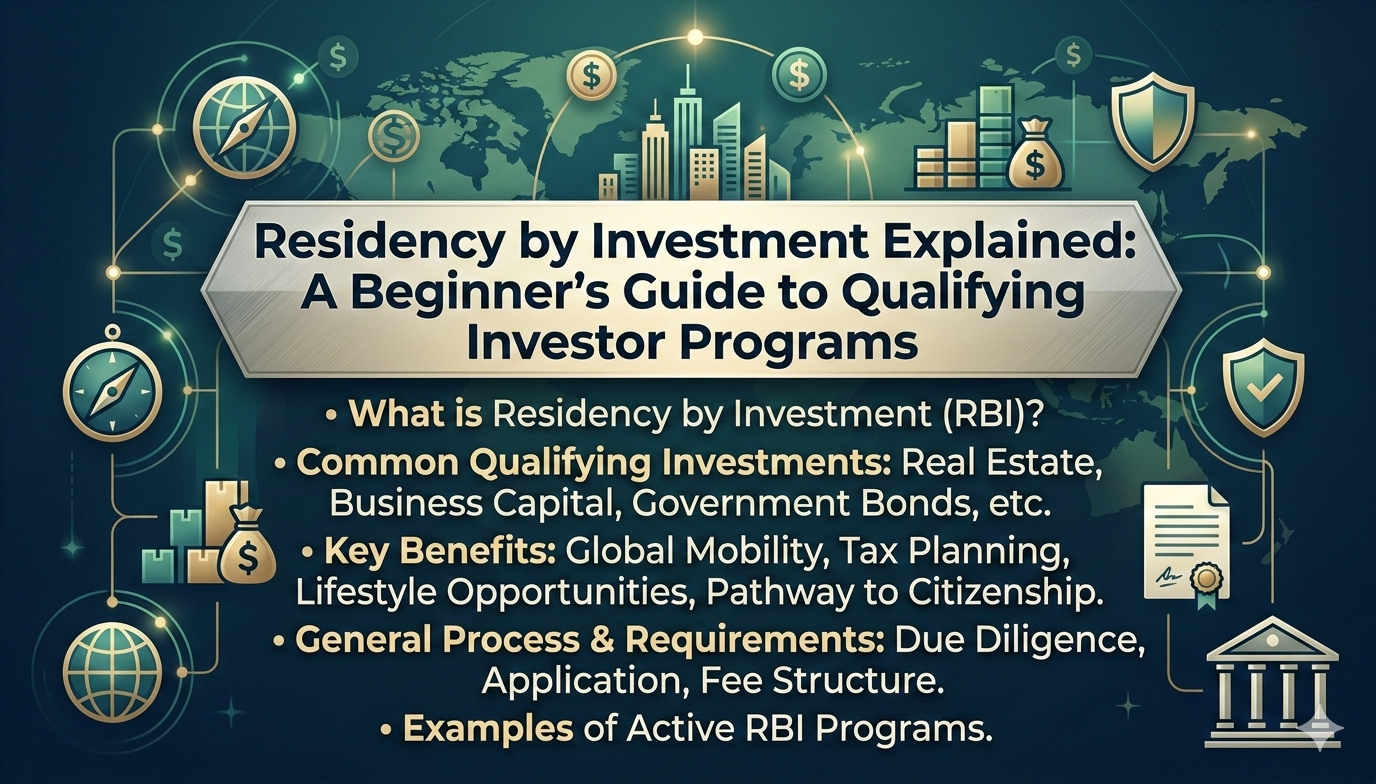
Investment programs Residency by investment (RBI) programs are programs that grant legal residence in a country to foreign nationals who fulfill a qualifying financial investment. Although this idea may sound easy, beginners may not realize the legal, financial, and compliance layers that can be encountered.
These programs in 2026 are more organized and more scrutinized than ever. Foreign capital is desired by governments, but foreign capital accompanied by transparency, clean funds and regulatory compliance. Before putting money into the system, it is important to know how it operates in reality rather than theory.
Such a beginner’s guide is a decent breakdown of the mechanics, responsibilities, schedules, and investor types that are generally appropriate in qualifying investor programs.
1. The Legal Structure of Residency by Investment Programs
Residency by investment programs run on the national immigration laws or special economic decrees. Each country defines:
Key Regulatory Requirements
- Minimum investment amounts
- Approved asset categories
- Required holding periods
- Due diligence standards
- Renewal and residency requirements.
As an example, programs like the panama qualified investor program are structured according to well-defined rules that stipulate both eligibility and compliance requirements.
Legal clarity is important in practice. Defined statutes in programs decrease the discretion of the immigration officers, which enhances predictability in the processing. Where rules are not clear or are regularly revised, it is possible that applications may suffer delays.
Practitioner Checklist for Legal Audits
- Legal underpinning of the program (law or decree)
- The nature of investment thresholds is fixed or variable.
- The program is temporary or direct permanent residency.
2. Typical Qualifying Investments
Most residency programs permit some or all of the following, although each country varies separately:
Acceptable Investment Categories
- Real Estate Purchase of value meeting the minimum as per the government.
- Regulated financial institutions: Fixed-Term Bank Deposits.
- Bonds or Securities of Government.
- Green Developments Projects.
- Organized Enterprise Investments.
In reality, real estate is usually preferred as it allows having a tangible asset. Bank deposits are attractive to applicants who want to get guaranteed exit schedules within the required holding periods.
Novices must consider liquidity, resale risk, and currency exposure in addition to the eligibility.
3. Who are the Beneficial Owners of Residency by Investment?
Residency by investment is not suitable for all.
Ideal Investor Profiles
- Business people are going global.
- Currency or political risk diversifies investors.
- Rich people in need of asset protection.
- Long-term mobility planning in families.
- People in countries where traveling is limited.
Profiles Not Suited for RBI
- Immediacy of citizenship is required of applicants.
- People who are not willing to hold on.
- Investors who could not present coherent documentation of the source of funds.
It is very important to understand fit. Numerous amateurs are interested in the advantages of mobility without considering the long-term requirements.
4. Process: How the Application Process Works in Real Life
Although the marketing materials make it easy, actual applications have a systematic step-by-step process.
General Global Standard: Typical Application Timeline
- Document preparation: 3–6 weeks
- Documentation collection on sources of funds: 2 to 8 weeks.
- Investment execution: 2–4 weeks
- 2-6 weeks Banking compliance review.
- Government scrutiny: 2-6 months.
Basic Application Milestones
- Primary eligibility assessment.
- Preparation of source-of-funds documentation.
- Transfer of capital in authorized channels.
- Official submission of residence.
- Background checks and security checks.
- Approval issuance
Practically, the majority of the delays appear in the course of banking due diligence or the expiration of the documents (police certificates) before submission.
5. Due Diligence and Source-of-Funds: The Two Areas Most Novices Trip-Up
The governments are becoming firmer when it comes to financial transparency.
Mandatory Applicant Disclosures
- Legal source of investment funds.
- Clean criminal background
- Checkable financial background.
- Legalized documents should be done appropriately.
Common Errors of Novice Applicants
- Handing in unfinished financial trails.
- Not decently documenting inheritance or business.
- Underrating increased banking checks.
- Delivery of obsolete background certificates.
The great majority of rejections come as a result of documentation shortages, not of the inadmissibility of the type of investment.
Official pre-submission audits help eliminate the risk of rejection to a large extent.
6. Tax, Compliance, and Continued Responsibilities
Tax obligations are not necessarily affected by residency.
Some countries have territorial taxation systems, i.e., the foreign-source income is not subject to local taxation. Others are subject to global taxation following the initiation of tax residency.
Essential Post-Approval Obligations
- Physical presence requirements: Minimum.
- Investment holding periods
- Permit renewal schedules
- Annual reporting requirement.
- Exit strategy compliance
Lack of compliance may lead to the revocation of residency. Residency is not a single exchange of law – it is a continuing legal association.
7. Gates to Permanent Residency and Citizenship
The temporary or provisional residence is initially given by many programs. To be eligible to obtain permanent residency, one may need:
Requirements for Permanent Status
- Nurturing the qualifying investment.
- Adherence to minimum stay requirements.
- More evidence of legal compliance.
To be a citizen, one must normally have:
Path to Citizenship Criteria
- A few years of legal establishment.
- Language or integration requirements.
- Clean legal record
Notably, citizenship is not automatic when one has residency. Novices need to schedule according to achievable statutory deadlines instead of marketing assertions.
Typical Risks Before Implementation
- Currency fluctuation risk
- Uncertainty and volatility in the real estate market.
- Regulatory changes
- Banking compliance examination.
- Tax residency on clash with the home country.
The 2026 standard of transparency is higher than in years past. Programs are no longer invalid, but the scrutiny of documentation has increased worldwide.
Important Lessons for First-Time Applicants
- The residency by investment is not automatic.
- The quality of documentation frequently dictates the rate of approval.
- The compliance of the banking is often the most prolonged step.
- The periods of investment holding should be honored.
- Preventable delays are minimized as a result of professional advisory support.
- Not every program applies to every type of investor.
The strategic financial choice of approaching residency by investment, and not merely a mobility purchase, will result in improved long-term outcomes.
The Informed Decision
The programs of the residency by investment provide organized access to legal residency, diversification of assets, and mobility. Nonetheless, they must be properly planned, transparent in terms of finances and conform to it.
Final Steps for Beginners
- Affirm legal organization and qualification standards.
- Determine the compatibility of the program with individual financial plans.
- Make full source-of-funds documentation.
- Know renewal and long-term obligations.
As long as there is adequate preparation and expectations, the qualifying investor programs can cease being a complicated notion and become a formal and easy process.